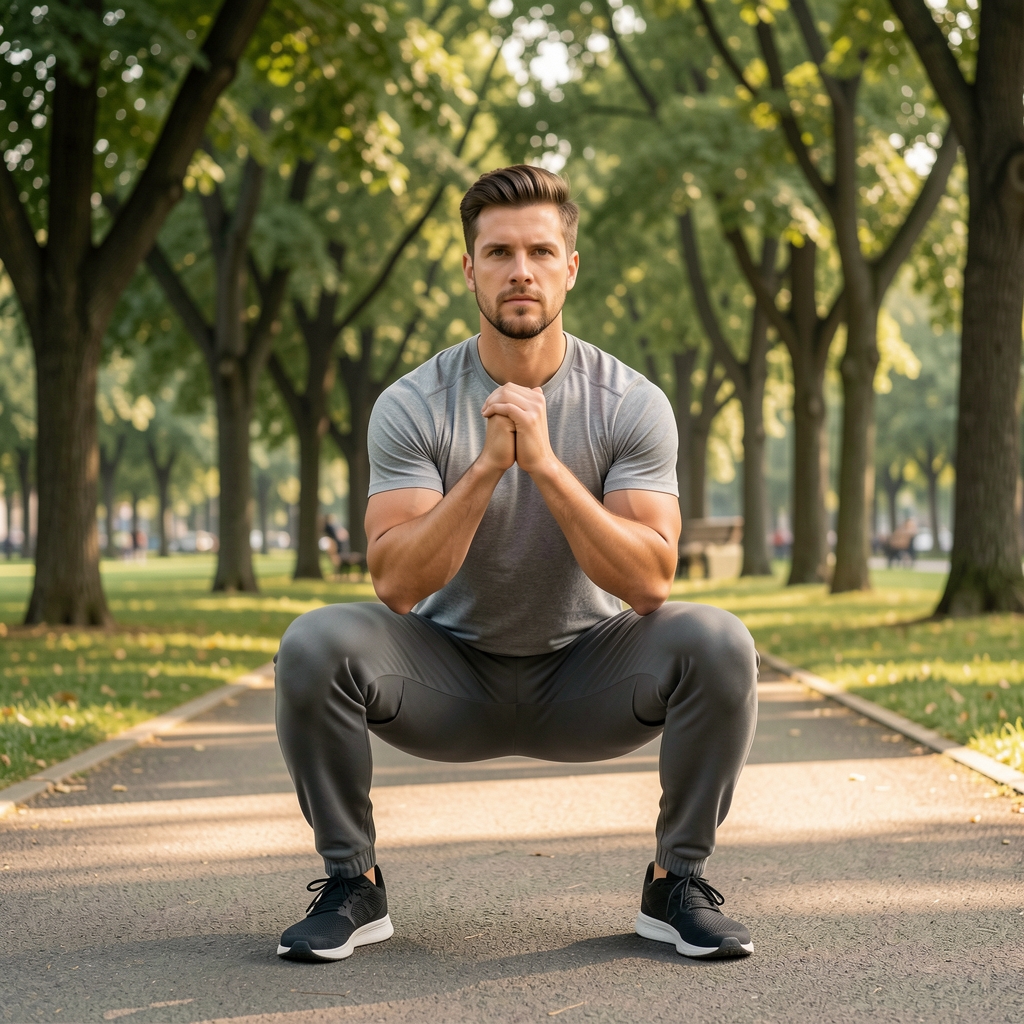
The squat is among the oldest human movement patterns. Its presence in daily life predates the construction of chairs, and its absence in contemporary sedentary routines is associated with the progressive loss of hip and ankle mobility that characterises many adult men over thirty. Performed outdoors with nothing but bodyweight, across a range of variations, the squat serves as both a strength exercise and a daily mobility assessment.
The Squat as a Mobility Marker
Before addressing the variations, it is worth establishing what a squat reveals about the body performing it. A full-depth bodyweight squat — heels flat, hips below parallel, torso reasonably upright — requires simultaneous mobility at the ankle, knee, and hip, combined with adequate lumbar and thoracic spine extension. Most adults who have not maintained squatting in their movement repertoire will present a limitation at one or more of these joints that prevents full depth without compensatory pattern.
The most common compensation in men is heel rise — the heels elevate as the hips descend because the ankle lacks sufficient dorsiflexion range to accommodate the movement without it. A secondary compensatory pattern is forward trunk lean beyond what hip anatomy requires, typically driven by the same ankle restriction redirecting the load forward. Both are observable in a standard park squat assessment and both are addressable through targeted mobility work and progressive squat practice.
viewing the squat as a daily assessment — performing it as the first movement of a session and noting where the body is relative to the previous session — gives a useful running picture of lower-limb mobility status. It is more informative than a static flexibility test because it reflects the integrated functional range across three joints under light load.
"A man who can squat deeply and stand without assistance has retained a fundamental physical capacity. That retention requires no equipment."
— Field observation, April 2026
Six Variations for Outdoor Practice
The variations below are arranged by approximate demand on lower-limb mobility and single-leg loading. All are executable in a public park or on any flat outdoor surface. None require equipment beyond the body and the ground.
Heels placed on a raised surface — a kerb edge, a low step, or a folded jacket. Reduces the ankle mobility demand and allows a more vertical shin angle. An appropriate entry point for men with limited dorsiflexion.
Feet significantly wider than hip-width, toes turned out thirty to forty-five degrees. Shifts demand from the hip flexors toward the hip adductors and inner thigh. Requires less ankle dorsiflexion than a narrow stance at equivalent depth.
Feet close together, toes forward or slightly out. Significantly increases the ankle dorsiflexion requirement. Used as a mobility challenge rather than a strength exercise at this variation level.
Begin in a deep squat hold, grip the toes, and extend the knees toward straight while maintaining toe grip. Alternates between hip flexion and posterior chain lengthening. A dynamic flexibility sequence as much as a strength exercise.
Wide stance, weight shifting to one side while the opposite leg extends with heel flat. Alternates between a deep single-leg squat and a loaded adductor stretch on the extended side. High hip mobility demand with considerable adductor lengthening.
Single-leg squat with the non-working leg extended forward. At the entry level, holding a park railing or post for balance. At intermediate level, freestanding with arms forward. High single-leg strength and mobility demand — the upper end of the bodyweight squat spectrum.
Ankle Mobility — the Persistent Limiting Factor
Ankle dorsiflexion — the ability to bring the shin forward over the foot while the heel remains grounded — is the most commonly reported limiting factor in bodyweight squat depth in men with sedentary occupational histories. The restriction can originate from the joint soft-gels, from tight calf musculature, or from both. The distinction matters because the approaches to each differ.
Gastrocnemius and soleus stretching addresses the muscular component. A straightforward standing calf stretch on a step edge — heel hanging below step level, held for forty-five to sixty seconds — targets the gastrocnemius when the knee is extended and the soleus when the knee is slightly flexed. Consistency over several weeks is required for meaningful change in resting length. A single session of stretching does not produce lasting adaptation.
The joint soft-gels component responds to a different stimulus — the knee-to-wall drill, in which the foot is placed close to a wall and the knee is pushed forward to contact the wall while the heel remains grounded. This places the ankle through its available dorsiflexion range under light load and progressively encourages greater range over time. In practice, both approaches run in parallel, performed before the squat session as part of the general warm-up.
Programming the Squat Variations Daily
A daily squat practice, at the mobility-maintenance level, does not require the recovery allowance of a strength-focused session. The volume is low — five to ten repetitions of each chosen variation, or a single deep hold for thirty seconds — and the intensity is well below the threshold that demands rest days. Daily repetition at low intensity is, in this context, the mechanism by which mobility is recovered and maintained. Intermittent high-volume squat sessions interspersed with inactivity are less effective at restoring functional range than consistent low-volume daily practice.
For men targeting strength development through squat variations — progressing toward the single-leg squat — a three-sessions-per-week approach is more appropriate, with rest days between sessions to allow the lower-limb musculature to adapt to the single-leg loading. At this stage, the squat transitions from a mobility exercise into a meaningful strength stimulus, and the recovery requirements change accordingly.
The park or outdoor environment contributes to this practice in a manner that indoor training does not: uneven ground, slight slopes, and the absence of mirrors and machines create an environment where the body must manage balance and positional awareness independently. The proprioceptive demand of a pistol squat entry performed on a grass slope is higher than the same movement on a flat gym floor. This is not a disadvantage of outdoor training — it is one of its defining characteristics.
The Role of the Squat in a Broader No-Equipment Session
In the context of a full no-equipment outdoor session, squat variations serve multiple roles depending on their placement in the session structure. Placed at the start, they function as an active warm-up — mobilising the hips, ankles, and thoracic spine while elevating core temperature. Placed mid-session, they provide lower-limb strength stimulus alongside the push-up progressions and plank series that address the upper body and trunk. Placed at session end, slow tempo squat variations and deep holds function as active recovery and flexibility work.
A session built entirely around squat variations — rotating through the six listed above at low volume and moderate tempo, with mobility work between sets — is itself a complete forty-minute outdoor session. No additional equipment, no pre-booked facility, and no dependency on weather beyond the willingness to train in it. That self-sufficiency is the practical argument for making squat variations the anchor of a no-equipment outdoor training programme.